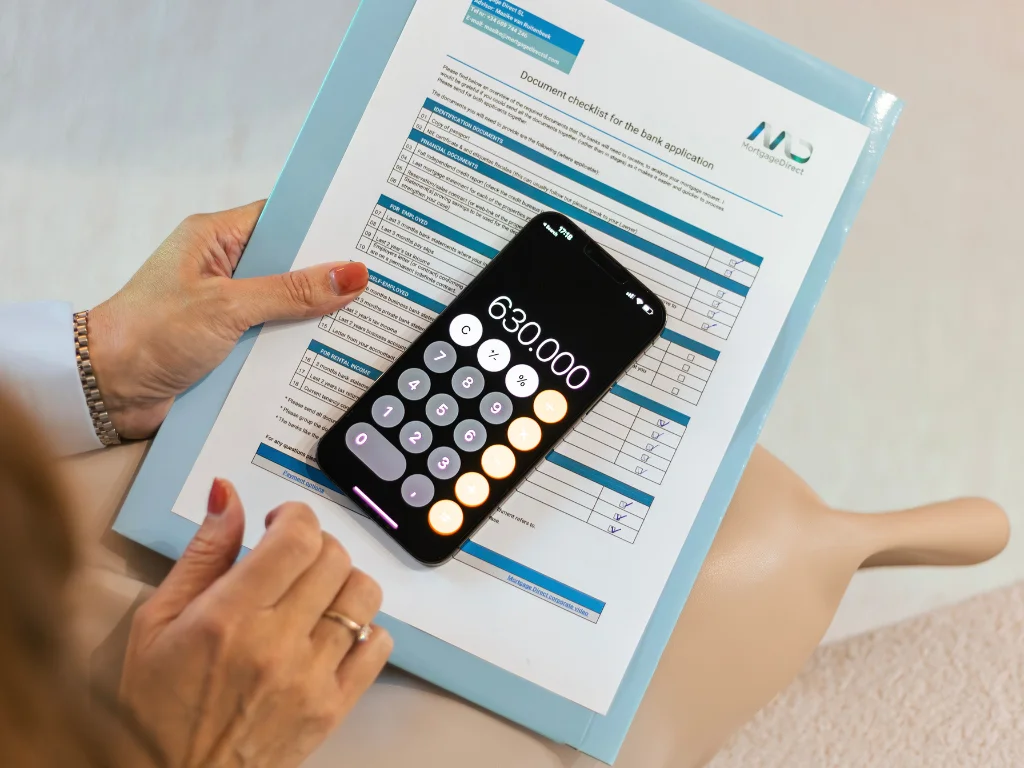
The Spanish purchase process is relatively structured, but it is not automatically protective of the buyer. Deadlines can move quickly, deposits may become non-refundable and purchasing subject to mortgage approval is not standard practice.
Several legal, financial and administrative processes must therefore progress alongside one another, often within a relatively short period.
The most successful purchases begin before an offer is made, with a clear understanding of the financing position, the capital required and the professionals who will guide the transaction.
WHAT THIS GUIDE COVERS
- Begin with the financing strategy
- A preliminary assessment within 24 to 48 hours
- Approval of the client’s financial profile
- The borrower and the property are assessed separately
- When should the property valuation be arranged?
- A lower valuation can increase the capital required
- Appoint an independent lawyer
- Obtain the necessary identification and banking arrangements
- Search for the property within a defined framework
- Making an offer
- The reservation agreement
- Legal due diligence and financing proceed in parallel
- The private purchase contract
- Final mortgage approval and documentation
- Preparing the purchase funds
Begin with the financing strategy
Many buyers begin by searching for a property and only investigate their mortgage options once they are ready to make an offer.
For international buyers in Spain, this order can create unnecessary financial risk.
Purchasing subject to finance is not customary in the Spanish property market. Although a financing condition may sometimes be negotiated, buyers should not assume that a reservation agreement or private purchase contract will automatically protect them if the mortgage is subsequently declined.
Once a reservation payment or deposit has been made, that money may be at risk if the buyer is unable to complete the transaction. The precise consequences depend on the wording of the agreement, which should always be reviewed by an independent lawyer before signing.
Before making a binding commitment, buyers relying on mortgage finance should understand:
- whether their financial profile is likely to be acceptable to an appropriate lender
- the approximate level and structure of financing available
- how much capital will be required for the purchase
- whether sufficient liquidity is available for taxes, fees and other acquisition costs
- how a lower-than-expected property valuation could affect the amount of equity required
Establishing these points early allows the property search to begin within a realistic financial framework.
A preliminary assessment within 24 to 48 hours
At Maaike van Ruitenbeek, the financing process can begin with a free and non-binding preliminary assessment.
Once the client has completed our information form, we normally provide an initial assessment within 24 to 48 hours.
At this stage, we can usually give a strong indication of:
- whether the client's profile is likely to be acceptable to suitable lenders
- the approximate mortgage amount that may be available
- the likely equity contribution and overall liquidity requirement
- the type of lender and financing structure that may be appropriate
- any potential areas that require further explanation or documentation
This preliminary assessment is not a formal mortgage approval.
It does, however, provide a reliable framework for the property search and helps the client avoid pursuing a transaction that may not be financially realistic.
Approval of the client's financial profile
Where a client wishes to obtain greater certainty before entering into a purchase, the application can be submitted to the lender’s credit or risk department. Once all required documentation has been received in complete form, this process typically takes approximately three weeks.
The lender will normally assess the client’s income, assets, liabilities, source of funds and proposed financing structure. For entrepreneurs, investors and internationally mobile families, this may involve explaining company ownership, retained profits, dividend income, investment assets or financial arrangements across several jurisdictions.
The way the application is prepared and presented is particularly important at this stage. Financial documents alone do not always reflect the client’s complete position.
Approval of the personal financial profile is not yet final approval of the mortgage, because the selected property must also meet the lender’s valuation and legal requirements. Nevertheless, many clients consider this level of approval sufficiently reassuring to begin negotiating or proceed with a purchase, subject to appropriate legal advice.
The borrower and the property are assessed separately
A Spanish lender must be satisfied with both the client and the property.
The first assessment concerns the borrower’s financial position and ability to support the proposed mortgage. The second concerns the property itself, including its value, legal status, condition and suitability as security for the loan.
A financially strong client may select a property that the lender is unwilling to finance. Equally, an acceptable property does not compensate for a financial profile that falls outside the lender’s underwriting criteria.
Mortgage approval should therefore not be viewed as one single decision. It is the result of several separate assessments coming together.
When should the property valuation be arranged?
The timing of the valuation depends on the circumstances of the transaction.
In many cases, we first seek approval of the client’s financial profile. The valuation is then arranged once the lender has confirmed that it is comfortable with the borrower. This sequence helps avoid asking the client to incur valuation costs before there is sufficient confidence that the financing can proceed.
There are, however, circumstances where it is sensible to arrange the valuation in parallel with the financial assessment.
This may be appropriate where:
- there is uncertainty regarding the property's market value
- the agreed purchase price appears ambitious
- the financing requirement depends closely on the valuation
- the property is unusual or located in a less liquid market
- the contractual timetable is particularly short
Running both processes simultaneously can reduce the overall timeline and identify valuation risk before the buyer makes a more substantial financial commitment.
The right sequence depends on the balance between speed, certainty and avoiding unnecessary costs.
A lower valuation can increase the capital required
Spanish lenders generally calculate the mortgage against the lower of the purchase price and the bank valuation.
This is particularly important where the agreed purchase price exceeds the valuation.
The lender may still be prepared to finance an agreed percentage of the valuation, but the buyer must fund the entire difference between the valuation and the purchase price.
That amount is required in addition to the normal equity contribution, taxes and acquisition costs.
A buyer who has calculated the required capital only by reference to the purchase price may discover that significantly more liquidity is needed shortly before completion. A sound financing strategy should allow for this possibility rather than assuming that the valuation will match or exceed the agreed price.
Appoint an independent lawyer
Every international buyer should appoint an independent Spanish lawyer before becoming contractually committed.
The lawyer acts for the buyer rather than the estate agent, seller, developer or lender.
The legal review will normally include:
- confirming ownership and title
- identifying mortgages, debts or other charges
- reviewing planning permissions and licences
- checking whether the property complies with applicable planning regulations
- reviewing community obligations and outstanding fees
- examining the proposed purchase agreement
- confirming the taxes and costs associated with the acquisition
Where the purchase involves a company, an investment structure, succession planning or cross-border tax considerations, additional specialist advice may also be required.
The legal, tax and financing structure should ideally be considered before the purchase contract is signed rather than after the transaction has been completed.
Obtain the necessary identification and banking arrangements
Foreign buyers generally require a Spanish foreigner identification number, known as an NIE, to complete a property purchase and meet the associated tax obligations. The application should be started early, as processing times can vary.
A Spanish bank account is also commonly required or at least highly practical. It may be used for mortgage payments, taxes, utilities, community fees and other ongoing property expenses. Where mortgage finance is required, the account-opening process will normally form part of the relationship with the lender.
Banks are required to verify the client’s identity, tax residence and source of funds. International buyers should therefore be prepared to provide supporting documentation well before completion.
Search for the property within a defined framework
Once the financial position is sufficiently clear, the property search can begin with a realistic budget.
The amount a buyer is prepared to spend and the amount a lender may be willing to finance are not necessarily the same.
A well-defined acquisition framework should consider:
- the purchase price
- taxes and transaction costs
- the minimum capital contribution
- liquidity to be retained after completion
- potential renovation or furnishing costs
- ongoing ownership expenses
- the effect of the mortgage on wider financial objectives
For private clients, the objective is rarely to maximise borrowing. It is to identify the level and structure of finance that best complements the wider financial position.
Making an offer
Once a suitable property has been identified, negotiations begin.
Offers are often made through the estate agent, although the precise process varies by transaction.
The negotiation may cover more than the purchase price. Other important matters can include:
- the proposed completion date
- which fixtures and furnishings are included
- the timeframe for due diligence
- access for the bank valuation
- whether any conditions are attached to the purchase
- how quickly the buyer is expected to sign and pay a deposit
A buyer with a clearly established financing position is usually in a stronger negotiating position than one who has yet to investigate whether a mortgage is available.
The reservation agreement
Once an offer has been accepted, the buyer is often asked to sign a reservation agreement and pay an initial amount to remove the property from the market.
This can happen quickly, particularly where there is competition for the property.
The reservation should not be treated as a purely administrative formality.
Before signing, the buyer’s lawyer should review the agreement and confirm
- whether the reservation payment is refundable
- under which circumstances it may be retained
- the deadline for legal due diligenc
- the proposed date for signing the private purchase contract
- whether a financing condition has been included
- what happens if the valuation is below the agreed purchase price
Where mortgage finance is required, the contractual timetable must also allow sufficient time for the lender to complete its assessment.
International applications often involve foreign tax returns, company accounts, investment statements and documents from several jurisdictions. These cannot always be reviewed within an unrealistically short deadline.
Legal due diligence and financing proceed in parallel
After the reservation, the legal and financing processes usually move forward simultaneously. The lawyer investigates the property while the mortgage adviser coordinates the client assessment, lender selection, valuation and approval process.
At this stage, close coordination matters. A legal issue affecting the property may influence whether the lender is prepared to accept it as security. A delay in receiving financial documents may affect the contractual timetable. A valuation below the purchase price may require the buyer to revise the financing structure or contribute additional capital.
Treating the legal work and the mortgage as separate processes increases the risk that an important issue is discovered too late.
The private purchase contract
Following satisfactory legal due diligence, the buyer and seller commonly sign a private purchase contract, often referred to as an arras agreement. At this stage, the buyer usually pays a substantially larger deposit.
The contract establishes the purchase price, completion date, obligations of the parties and consequences if either side fails to complete. A commonly used structure is the arras penitenciales. Under this form, a buyer who withdraws may lose the deposit, while a seller who withdraws may be required to repay twice the amount received. However, the legal consequences depend on the precise wording and type of contract. Buyers should rely on their lawyer’s advice rather than assume that every arras agreement operates in the same way.
Most importantly, an unsuccessful mortgage application does not necessarily release the buyer from the contract. Unless an effective financing condition has been expressly negotiated and included, the failure to obtain a mortgage may remain the buyer’s risk.
Mortgage-dependent buyers should therefore avoid signing an arras contract until their financing is sufficiently advanced and the remaining risks are clearly understood.
Final mortgage approval and documentation
Once the client and property have both been approved, the lender prepares the formal mortgage documentation.
This sets out the final conditions of the loan, including:
- the mortgage amount;
- interest-rate structure;
- term;
- monthly repayment;
- fees and related costs;
- early repayment conditions;
- any required banking or insurance arrangements.
The client must be given sufficient time to review the formal mortgage terms before completion.
The notarial process for the mortgage may also include a separate meeting or formal review before the mortgage deed can be signed.
During this period, the adviser, lawyer, lender and notary coordinate the outstanding documentation and completion timetable.
Preparing the purchase funds
Before completion, the buyer must ensure that all funds are available in the correct place and form.
These may include:
- the balance of the purchase price;
- taxes and transaction costs;
- legal and notarial fees;
- registration expenses;
- any amount not covered by the mortgage;
- additional capital required following a lower valuation.
The bank and lawyer may also require evidence showing where the funds originated.
For international buyers, large transfers should be planned carefully. Bank limits, currency conversion, compliance checks and transfer times can otherwise cause avoidable delays.
Where the buyer’s capital is held in another currency, the timing and method of conversion can also have a material effect on the final euro amount available.
Completion before the notary
The purchase is completed before a Spanish notary.
The notary verifies the identity of the parties, checks that the legal formalities have been followed and records the transfer of ownership in a public deed.
The notary is independent and does not replace the buyer’s own lawyer.
At completion, the purchase deed is signed, the remaining purchase funds are transferred and possession is usually delivered to the buyer.
Where mortgage finance is involved, the mortgage deed is generally signed as part of the same completion process.
Once the transaction has completed, the buyer receives the keys and becomes the legal owner of the property.
What happens after completion?
Several administrative matters remain after the notarial signing.
These normally include:
- payment of the applicable acquisition taxes;
- registration of the title deed at the Land Registry;
- registration of the mortgage;
- transfer of utilities;
- notification of the community of owners;
- arranging direct debits for local taxes and ongoing expenses;
- retaining copies of the completion and tax documents.
The buyer’s lawyer will generally coordinate these matters and confirm once the title has been registered.
Owners should also consider insurance, wills, succession planning and the ongoing tax obligations associated with holding property in Spain.
The professionals involved in the purchase
A Spanish property transaction may involve several different professionals.
The estate agent represents the commercial side of the transaction and often acts for the seller.
The lawyer protects the buyer’s legal interests and carries out the due diligence.
The mortgage adviser assesses the financing strategy, identifies suitable lenders, prepares the application and coordinates the approval process.
The bank assesses the borrower and property and provides the mortgage.
The valuer determines the property value for lending purposes.
The notary formalises the transfer and mortgage deeds.
A tax adviser may be needed where the acquisition involves cross-border planning, companies, succession or more complex ownership arrangements.
Each party has a distinct role. The process works best when responsibilities are clear and the advisers communicate from the outset.
A well-managed purchase sequence
Although every transaction is different, the process will generally follow this order:
- Establish the financing strategy and available capital.
- Complete the preliminary assessment.
- Collect the documentation required for lender review.
- Obtain approval of the personal financial profile where appropriate.
- Appoint an independent lawyer and obtain an NIE.
- Begin the property search within a realistic budget.
- Make an offer and agree to the commercial terms.
- Have the reservation agreement reviewed before signing.
- Complete legal due diligence.
- Arrange the valuation at the appropriate stage.
- Obtain approval of both the borrower and the property.
- Sign the private purchase contract once the risks are understood.
- Review and complete the formal mortgage process.
- Arrange the purchase funds and complete before the notary.
- Finalise taxes, registration and post-completion administration.
The stages may overlap, but the sequence should remain deliberate.
Our perspective
Buying a property in Spain is rarely complicated because of one individual step.
The risk arises when financing, legal due diligence, valuation and contractual deadlines are treated as separate matters rather than parts of one coordinated transaction.
Finding the property first and arranging the mortgage afterwards may appear logical, but it can expose the buyer to avoidable financial risk.
In Spain, the moment a reservation payment is made or an arras contract is signed, the consequences of an unsuccessful mortgage application can become financial rather than merely administrative.
The safest process begins with clarity.
Clarity around the financing available, the capital required, the acceptability of the client’s financial profile and the possible risks associated with the property.
When these elements are addressed before the buyer becomes fully committed, the purchase process becomes significantly more predictable.
The objective is not simply to complete a property purchase.
It is to acquire the right property with a financing structure that supports the buyer’s wider financial objectives and with the risks understood from the outset.